
That Sticky-Outy Hair
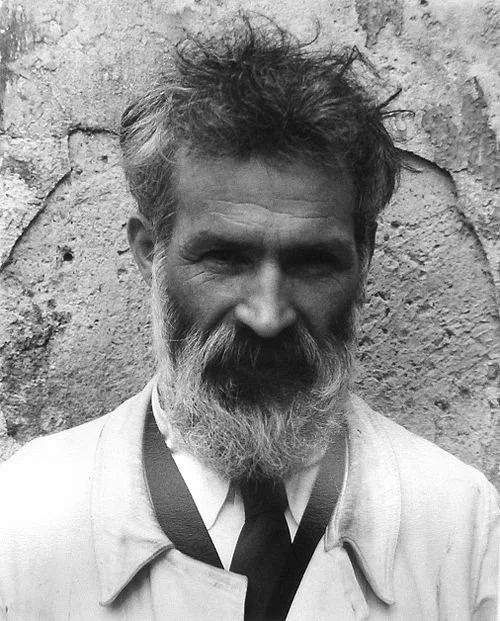
Constantin Brancusi. Photo credit: Edward Steichen, Wikimedia Commons.
5:30 am this morning. In the thick, felted, pre-dawn darkness of our room I’m lying in bed having words with Constantin. Gentle but firm words in French, our common language.
Ne sois pas radin avec ta passion, Constantin. Tes oeuvre sont d’un généreux, elles sont puissantes. Elles incarnent l’éternel, l’infini, la sensualité, le divin… Mais les mots sont trop maigres pour les décrire; faibles, meme laids. Raccontes-moi, plutôt.
Don’t be stingy with your passion, Constantin. Your works are so generous and powerful. They embody the eternal, the infinite, sensuality, the divine… But words are too thin to describe them; weak, ugly even. You tell me instead.
I want him to share with me his effort to capture essence, strength, fragility and to distill it in his works. I want to be part of his quest. I want him to include me in the world that he translates into his eloquent, elegant sculptures.
As usual he grumbles gruffly in Romanian - dismissive - through his thick wiry beard. I make out words like woman… talking… work. But I know he’s heard me. He’s turning my words over in his mind, his deep-set black eyes glinting and his sticky-outy hair standing up straighter than normal in every direction, bristling with energy.
Paweł wakes up beside me and asks how I slept. I tell him about the conversation I’d just had with my lover, the 20th century Romanian sculptor Constantin Brancusi. How I wanted him to share his thoughts even though the words could never do justice his work because it’s about the ineffable.
And how that’s why art is so important to me. It makes me feel less alone. Art, literature, film, dance, it makes me feel connected to a web; it’s like a compass or a North Star that shows me the way, whether it’s beautiful or joyful or horrifying or saddening or disturbing.
Art is the markers on a road. It affords glimpses into what it means to be human so that I feel less overwhelmed and lost, unmoored and disoriented, by the vastness of life and of being in the world.
[Did I mention that during the night I had a dream about swimming, lost, in the ocean, unable to find my way back to land? Thankfully, I was quickly saved by a boat with two tourists who’d seen me bobbing in the water, beginning to panic. It’s been a busy night].
I tell Pawel how sometimes art is the only thing that makes sense to me. People making things that have to do with being human or with love or loss or the natural world… things that are microscopic or things that are far bigger than us. And how as a teenager, when I first saw Brancusi’s Bird In Space it felt like a vista on a whole new continent.
Paweł gets it. He knows this about me and answers, “That’s what scientists do, too.”
“Yes,” I say, “Seek the Divine.”
“I don’t know if that’s what I’d call it,” he answers (words like that make him squeamish). “Maybe some would. But I think of it more as looking for… something above the clouds. Not taxes, not getting car brakes fixed, or taking out the trash.“
“Something that connects us to the wider world or cosmos,” I suggest. He murmurs in agreement and nods into the pillow. “Wasn't it Carl Sagan who said we’re all star stuff?”
Yes, he replies. Then I get up to let the dog out.
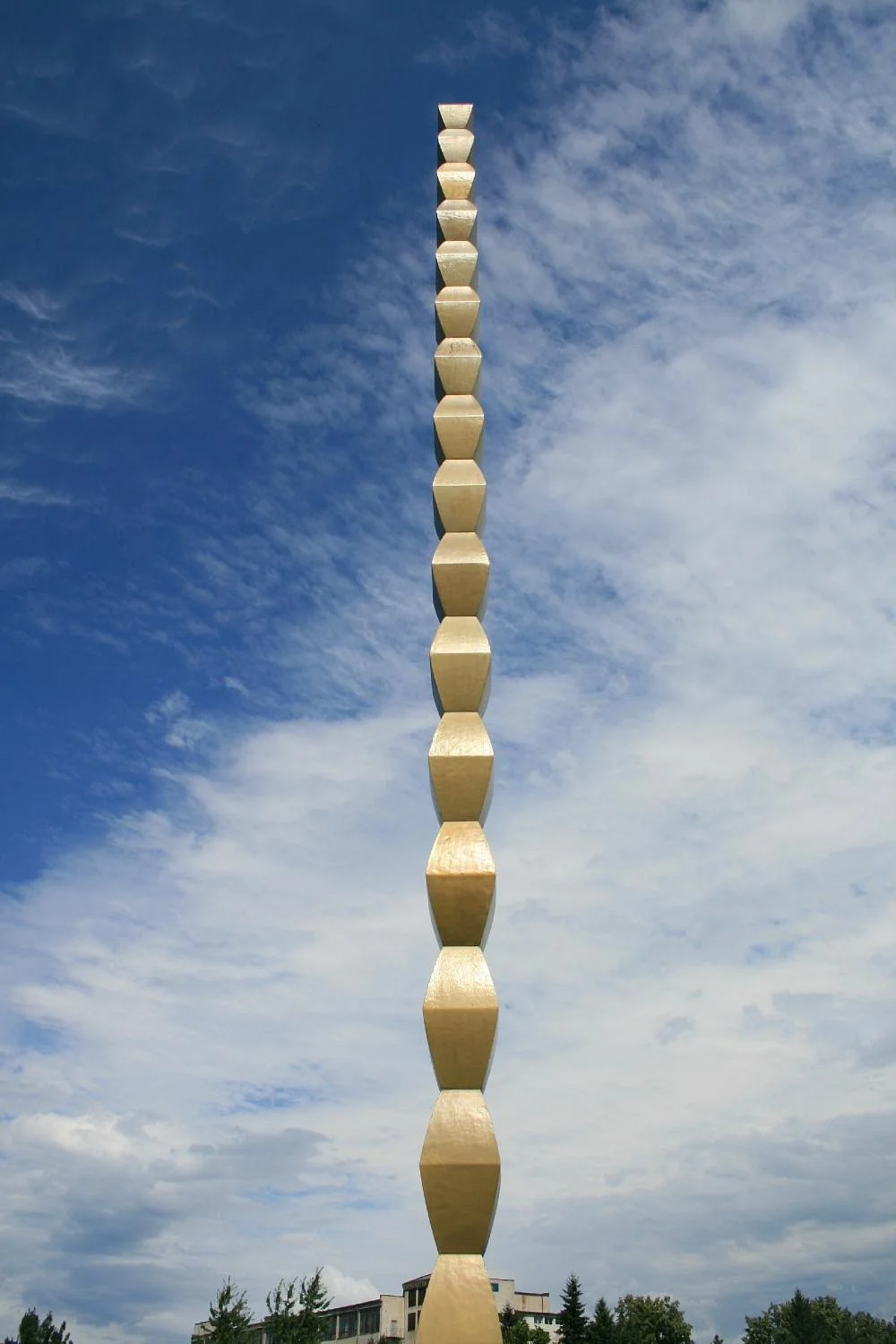
Contstantin Brancusi, Endless Column, 1938. Târgu Jiu, Romania. Photo credit: Wikimedia Commons.